

Why Acceleration Sense Matters
One of the most common challenges for new drivers is poor throttle control—either pressing too hard or too gently. This results in jerky take-offs, unstable turns, erratic speeds, and inconsistent following distances. Learning to recognize and respond appropriately to how the car reacts under your right foot is a foundational skill for safe, smooth driving.
This principle is at the core of Roadcraft: The Police Driver’s Handbook, the advanced driver training guide used by UK police. In the System of Car Control, acceleration should only occur after observation, positioning, speed adjustment, and gear selection are complete. Acceleration is not a reflex—it is a deliberate, final action based on accurate judgment.
What Is Acceleration Sense?
Acceleration sense is your ability to judge:
- When to accelerate
- How much to apply
- How quickly to reach the desired speed
It involves: - Sensitivity in your right foot
- Awareness of engine sound
- Observation of traffic flow and distances
- Feeling the car’s momentum and weight transfer
Roadcraft emphasizes that you should only apply throttle when the road ahead is visible, your position is correct, and your vehicle is stable. Acceleration should always be purposeful—not reactive.
Common Throttle Mistakes by Beginners
- Sudden surges during take-off
- Forgetting to adjust throttle while cruising (inconsistent speeds)
- Failing to reduce throttle before a turn
- Hesitating to accelerate uphill, leading to slow merges
Practical Scenarios Where Acceleration Sense Matters
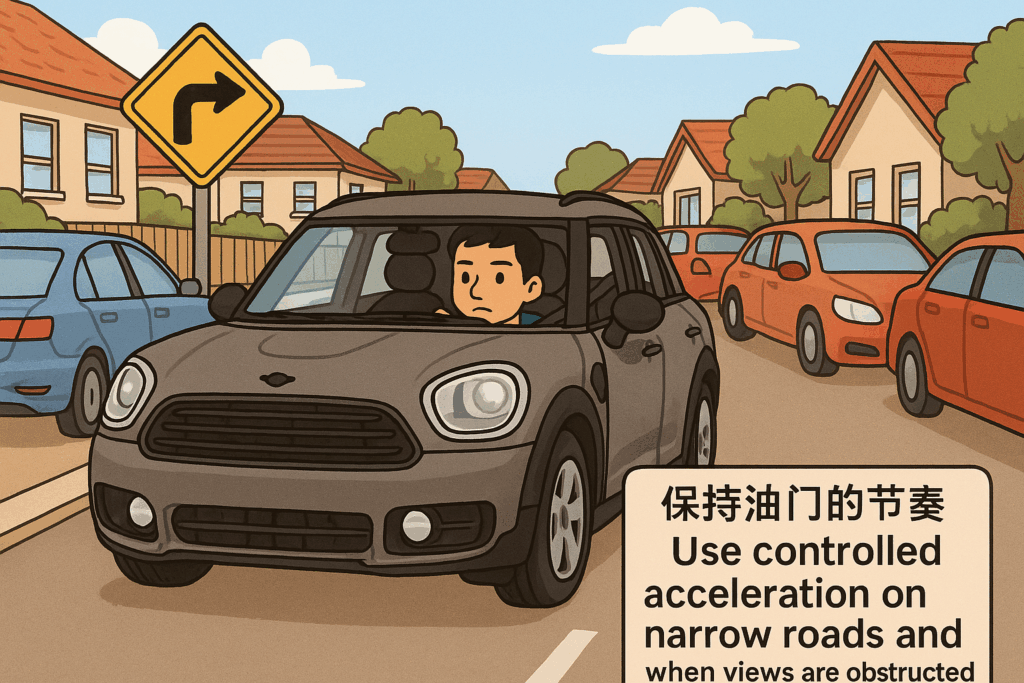
Example 1: Turning left into a narrow residential street with parked cars on both sides
Do not immediately accelerate to the speed limit. Narrow space and blocked visibility increase the chance of hidden pedestrians or cyclists emerging.
→ Roadcraft insight: You are still in the Observation and Positioning phase—acceleration comes later.
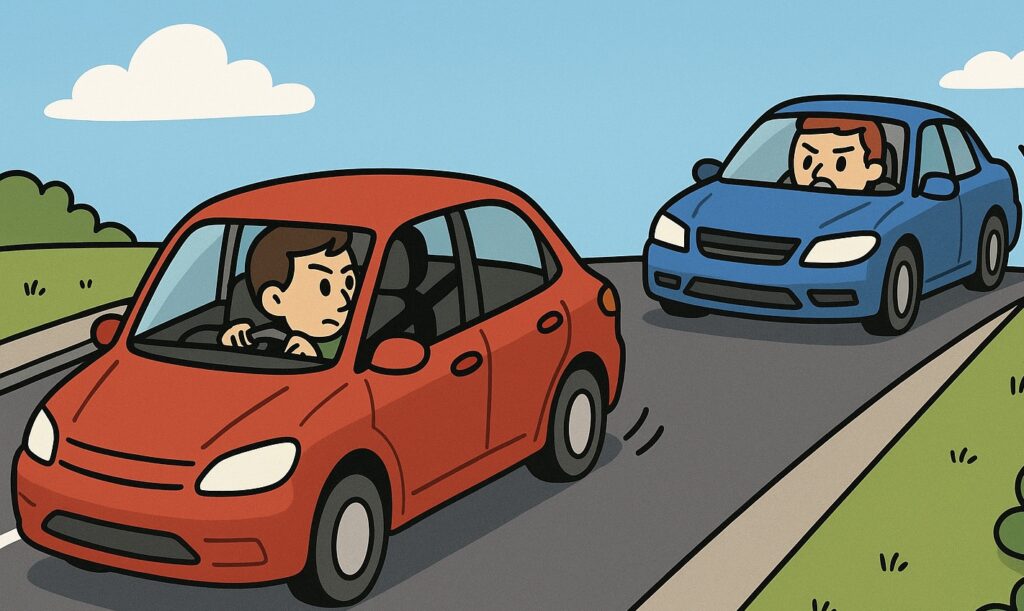
Example 2: Turning right from a side street onto a main road (uphill)
Once it is safe to go, you must apply enough throttle to quickly build up speed and match the traffic flow. On a slope, timid acceleration will leave you too slow, creating a hazard for following vehicles.
→ Roadcraft insight: Once observation is clear and your position is correct, move confidently through the Acceleration phase to merge smoothly.
Example 3: Approaching a bend while heading uphill, with limited visibility ahead
Ease off the throttle before the bend to maintain control. Once your line of sight is clear after the turn, reapply throttle gradually to regain speed.
→ Roadcraft insight: You are still in the Hazard Approach stage. Throttle should not resume until the bend is cleared and vision ahead is restored.
How to Train Your Acceleration Sense and Throttle Rhythm
1. Use your ankle—not your whole leg
Keep your heel on the floor and adjust throttle pressure using only your ankle. This builds precise control and prevents jerky inputs.
2. Avoid “flapping foot” (accordion-style throttle)
Do not hover your foot in the air or pump the throttle. Keep movements subtle and stable for smooth speed control.
3. Sync your foot with eyes and ears
After applying throttle, watch how your speed increases, listen to engine pitch, and observe the gap between your car and others.
4. Practice stable acceleration from zero to limit
On a quiet, straight road, practice going from 0 to 50–60 km/h smoothly. Learn how much throttle you need and how long it takes to get up to speed without sudden surges.
5. Always train with the same shoes and car
Different shoes change your foot feel. Different cars have different pedal sensitivities. Use the same car and shoes during training to build consistent muscle memory.
Reminder:
The throttle is not a switch—it’s a precision dial. Acceleration is not about boldness—it’s about timing, awareness, and control.
According to Roadcraft, you should never accelerate until observation is complete, the car is in position, the hazard has been assessed, and your vehicle is stable. Once those conditions are met, accelerate confidently and smoothly.
Mastering acceleration sense means driving with intent—not hesitation, not guesswork. And that’s exactly what your VORT examiner wants to see.


